Algorithms, Data, and Platforms Must Serve the Common Good - FAMVIN NewsEN


The OER Observatory aggregates and displays OER-related news and content from third-party sources worldwide. This content is not produced by UNESCO or the OER Dynamic Coalition. All rights and responsibility for the original content remain with the respective authors and publishers. The inclusion of third-party content in the Observatory does not imply endorsement by UNESCO or the OER Dynamic Coalition. Users can access the original source through the link provided with each item.
"Among the numerous implications of the common good, immediate significance is taken on by the principle of the universal destination of goods." First of all, this principle reminds us that the earth's goods -- soil, water, air and natural resources -- are given by God to the entire human family to sustain the lives of all, and that every person has an inherent right to the use of such goods, both now and in the future.
John Paul II recalled that, "God gave the earth to the whole human race for the sustenance of all its members, without excluding or favoring anyone." Consequently, "it is not in accordance with God's plan to use this gift in such a way that its benefits accrue solely to a select few." Today, we are called to recognize that this universal destination applies not only to material goods, but also to immaterial and cultural goods.
Certainly there is a right to private property, which has its own specific meaning and purpose, yet it is always subordinate to the universal destination of goods. According to John Paul II, this subordination is the golden rule of social conduct and the "first principle of the whole ethical and social order." In the Church's tradition, property has been viewed as a means of protecting and managing goods so that they may better serve the common good.
Since "the Christian tradition has never recognized the right to private property as absolute or inviolable," its social function must not be considered a mere theological opinion, but a doctrine of the Church, already present in Sacred Scripture and in the writings of the Church Fathers. For this reason, Pope Francis reminded us that solidarity, when lived out in its fullest sense, also means "to restore to the poor what belongs to them."
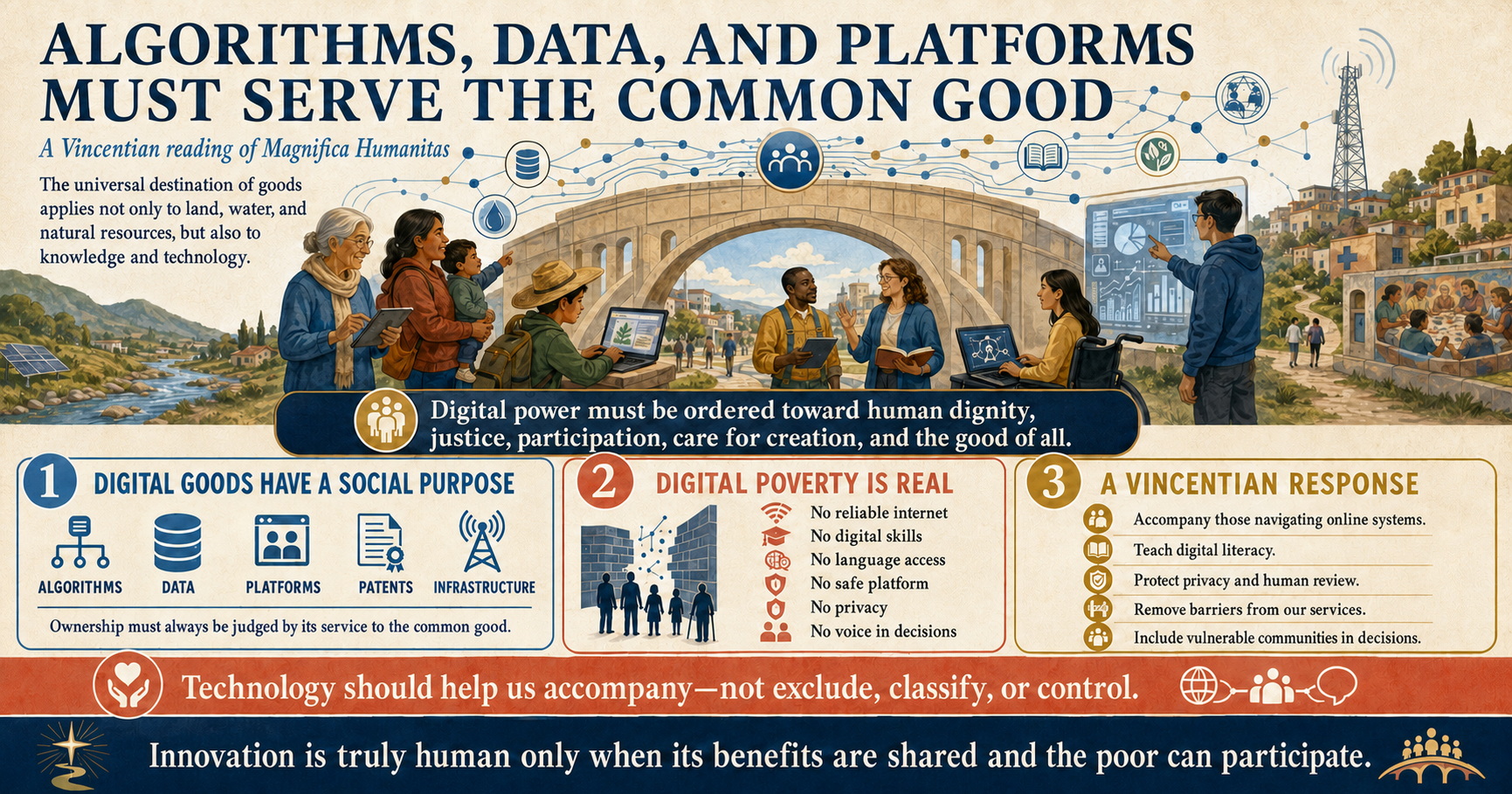
Today, among the goods that are universally intended for everyone, we must also include new forms of property, such as patents, algorithms, digital platforms, technological infrastructure and data. In a context where the wealth of nations depends increasingly on knowledge and technology, when these goods remain concentrated in the hands of a few, without adequate forms of sharing and access, a new imbalance is created that contradicts the universal destination of goods.
In turn, it widens the gap between the included and the excluded, between those who can participate in the digital revolution and those who remain on the margins.
Furthermore, care for our common home and our responsibility toward the poor and future generations require that the use of the goods of creation and the new possibilities offered by technology be regulated in such a way as to respect the environment, avoid waste and prevent new forms of exploitation."
Magnifica Humanitas, paragraphs 65-67.
In this passage, Pope Leo XIV applies one of the classic principles of Catholic social teaching to the digital age. The universal destination of goods has traditionally reminded Christians that the goods of the earth are given by God for the benefit of the entire human family. Private property has value and legitimacy, but it is never absolute. It has a social function and must serve the common good.
The Pope's decisive contribution here is to extend this principle explicitly to new forms of property: patents, algorithms, digital platforms, technological infrastructure, and data. These are not secondary realities in today's world. They increasingly shape economic power, education, health care, communication, public life, employment, scientific research, and access to opportunity.
This means that the digital world must also be judged by the demands of justice. If knowledge, technological infrastructure, and data are concentrated in the hands of a few, society creates a new form of inequality. Some people and nations participate fully in the digital revolution, while others remain outside it. Some become builders of the future; others become merely users, consumers, sources of data, or invisible outsiders.
For the Vincentian Family, this passage is especially important because it asks us to look at digital poverty not as a minor inconvenience, but as a serious question of justice. In a world increasingly organized through technology, exclusion from digital goods can become exclusion from education, work, health care, social participation, and human dignity.
A Christian Look at Our Changing World
The principle of the universal destination of goods is one of the most powerful and demanding elements of Catholic social teaching. It begins from a simple theological conviction: creation is a gift from God intended for all. The earth is not given to a few so that they may accumulate without limit while others are deprived of what they need to live. The goods of creation are entrusted to humanity so that every person and every people may have what is necessary for a dignified life.
This does not eliminate private property. Catholic social teaching has consistently recognized the value of property, personal initiative, creativity, and responsible management. Property can protect freedom, support families, encourage responsibility, and help organize social life, but property is never absolute. It is always subordinate to the common good because everything ultimately belongs to God.
Pope Leo XIV takes this ancient principle and applies it to a new world. In previous eras, people may have thought mainly of land, water, forests, food, housing, tools, or natural resources. Today, however, some of the most decisive "goods" are immaterial: knowledge, research, digital infrastructure, data, platforms, algorithms, patents, and technological capacity.
This is not a minor extension. It is a major development of social teaching for the digital age.
The wealth and power of nations increasingly depend on access to knowledge and technology. Education, health care, employment, finance, communication, transportation, social services, migration procedures, public administration, agriculture, energy systems, and even political participation are being shaped by digital infrastructures. Those who control these infrastructures influence not only markets, but daily life itself.
If such goods are concentrated in the hands of a few, a new form of inequality emerges. It is not only the inequality between those who have money and those who do not. It is the inequality between those who can shape technological systems and those who must live under them; between those who own data and those whose lives are turned into data; between those who design algorithms and those judged by them; between those who have access to digital tools and those left behind by them.
This raises urgent moral questions. Who benefits from the digital economy? Who pays the hidden cost? Who has access to education and digital literacy? Who owns the data generated by ordinary people? Who profits from the attention, behavior, and vulnerability of users? Who can challenge automated decisions? Who is excluded because of poverty, age, language, disability, geography, or lack of documentation?
Theologically, this passage reminds us that the common good must be protected not only in physical spaces but also in digital environments. A digital platform is not merely a private commercial space if it shapes public conversation, political imagination, economic opportunity, education, and social belonging. Data are not morally neutral if they are extracted from human lives and used to predict, influence, exclude, or profit. Algorithms are not simply technical instruments if they affect access to work, credit, housing, services, health care, or information.
The Christian vision insists that all forms of power must be ordered toward the dignity of the person and the good of all. This includes digital power. The question is not whether innovation should be stopped, but whether innovation is being governed by justice. A society that celebrates technological progress while tolerating digital exclusion is building a divided future.
The passage also connects the universal destination of goods with care for our common home and responsibility toward future generations. This is important. Digital technology is often imagined as clean, weightless, and immaterial. Yet it depends on energy, minerals, labor, supply chains, hardware, water, land, and waste systems. The digital world has an ecological footprint. It also has human costs, often borne by workers and communities far from the centers of technological wealth.
Therefore, the use of technological goods must be regulated in a way that respects the environment, avoids waste, and prevents new forms of exploitation. This is not hostility toward innovation. It is moral responsibility. The more powerful technology becomes, the more important it is to ask whether its benefits are shared, whether its harms are acknowledged, and whether the poor and future generations are protected.
For Christians, the universal destination of goods is ultimately an expression of God's generosity. God gives so that all may live. When a few accumulate the goods needed by many, they contradict the logic of creation. When knowledge, technology, and data become instruments of exclusion, they betray their social purpose.
The digital age therefore requires a renewed sense of stewardship. Algorithms, data, platforms, patents, and infrastructure must not become new idols of ownership and control. They must be placed at the service of human dignity, justice, participation, care for creation, and the common good.
A Vincentian Reflection
For the Vincentian Family, this passage opens a crucial field of reflection and action. Vincentian service has always responded to concrete forms of poverty. In the time of Saint Vincent de Paul and Saint Louise de Marillac, poverty often appeared in the form of hunger, sickness, abandonment, lack of education, war, displacement, and rural neglect. In the time of Blessed Frédéric Ozanam, the rise of industrial society created new forms of urban poverty, labor exploitation, and social fragmentation.
Today, alongside these enduring forms of suffering, we must recognize digital poverty.
Digital poverty is not simply the absence of a device. It includes lack of internet access, lack of digital skills, lack of language accessibility, lack of safe platforms, lack of privacy, lack of representation in data, lack of access to technological education, and lack of voice in systems that increasingly shape people's lives. It affects children who cannot complete schoolwork online, older adults who cannot access services, migrants who cannot navigate digital procedures, workers displaced by automation, rural communities without infrastructure, and poor families whose access to opportunities is limited by technology.
A Vincentian reading of the universal destination of goods asks us to see these exclusions as questions of justice. If digital systems now mediate access to education, employment, health care, legal assistance, public benefits, banking, communication, and social belonging, then exclusion from digital goods becomes a serious wound in the common good.
Saint Vincent would not have ignored this. He had a remarkable ability to recognize the practical barriers that kept people from receiving care: lack of organization, lack of resources, lack of transportation, lack of coordination, lack of pastoral attention, lack of social responsibility. He organized charity because the poor needed real access, not merely good intentions. In our time, digital access and technological justice must become part of that same practical charity.
Saint Louise also teaches us that service must be both tender and competent. It is not enough to feel compassion for those excluded by digital systems. We must ask how our own institutions, programs, schools, universities, parishes, and associations may unintentionally create barriers. Do we assume everyone can fill out online forms? Do we communicate only through digital channels? Do we ask people to upload documents they do not know how to scan? Do we provide services only to those who can navigate a platform? Do we collect data without explaining how it will be used? Do we protect the privacy of people whose lives are already vulnerable?
Blessed Frédéric Ozanam reminds us that charity must ask social questions. Digital inequality is not only a personal problem to be solved by individual effort. It is also structural. It is shaped by education systems, economic policies, corporate practices, public infrastructure, language access, international inequalities, and the concentration of technological power.
Vincentian action must therefore include both accompaniment and advocacy.
The encyclical's mention of patents, algorithms, platforms, infrastructure, and data is especially important for Vincentian institutions in education and social service. Catholic and Vincentian universities, schools, research centers, and formation programs have a responsibility to ask how knowledge and technology can be shared more justly. Are we preparing students to compete in the digital economy only for personal success, or are we forming them to place their skills at the service of the common good? Are we teaching digital literacy as a tool for empowerment? Are we helping young people understand the ethical dimensions of data, AI, and technological power?
For Vincentian social ministries, the challenge is equally concrete. If we use databases, case- management systems, online applications, digital fundraising platforms, or AI-assisted tools, we must ask whether these serve the dignity of the poor. Technology should help us remember, accompany, coordinate, and advocate. It should not reduce people to entries in a system. It should not make assistance colder, more distant, or harder to access.
The phrase "to restore to the poor what belongs to them" is deeply Vincentian. It reminds us that service to the poor is not merely generosity from those who have to those who lack. It is also justice. The poor have a claim on the goods of the earth and, in our time, on the goods of knowledge, technology, and participation. Their exclusion is not simply unfortunate. It is a contradiction of God's intention for creation.
This does not mean that every technological good must be free in the same way or that every form of ownership is unjust. It means that ownership must be judged by its social function. The question is whether technological goods are being managed so that they serve life, dignity, participation, and the common good, or whether they are becoming instruments of concentration, dependency, waste, and exclusion.
A Vincentian approach would seek practical responses: digital literacy programs for the poor; accompaniment for older adults navigating online systems; advocacy for affordable internet access; ethical guidelines for data collection; protection of privacy; inclusion of vulnerable communities in technological decisions; partnerships with universities and technology professionals; open educational resources; and formation that helps young people use technology for service rather than self-promotion.
The universal destination of goods calls the Vincentian Family to expand its imagination. Bread, shelter, medicine, education, and work remain essential, but in the digital age, access to knowledge, data justice, technological participation, and digital dignity are also part of the struggle for a more human world.
Algorithms, data, and platforms must serve the common good because they now shape the conditions under which the poor seek dignity, opportunity, and belonging.
Summary
In paragraphs 65-67 of Magnifica Humanitas, Pope Leo XIV applies the principle of the universal destination of goods to the digital age. The goods of creation are given by God for the entire human family, and private property, while legitimate, is always subordinate to the common good. This principle now applies not only to material goods such as land, water, and natural resources, but also to immaterial and cultural goods.
The Pope specifically names patents, algorithms, digital platforms, technological infrastructure, and data. When these are concentrated in the hands of a few, new forms of inequality emerge. The gap grows between those who can participate in the digital revolution and those who remain on the margins.
For Vincentians, this passage calls attention to digital poverty and technological exclusion. Access to technology, digital literacy, data protection, and participation in technological decisions are now part of the struggle for human dignity and justice. Vincentian service must ensure that digital tools do not become new barriers for the poor, but instruments of inclusion, empowerment, and the common good.
Algorithms, data, and platforms must serve the common good.
Questions for Group Dialogue
* What phrase from paragraphs 65-67 most challenges or surprises you?
* How do you understand the principle of the universal destination of goods?
* What changes when we apply this principle not only to land, water, and natural resources, but also to patents, algorithms, platforms, infrastructure, and data?
* Where do you see digital goods being concentrated in the hands of a few?
* Who in our local community is excluded from full participation in the digital world?
* What forms of digital poverty do we encounter among the people we serve?
* Do our ministries, schools, parishes, or institutions unintentionally create digital barriers for poor people, older adults, migrants, people with disabilities, or those with limited education?
* How can technology become an instrument of inclusion rather than exclusion?
* What responsibilities do Vincentian universities, schools, and formation programs have in promoting digital justice?
* How should Vincentian ministries protect the privacy and dignity of the people whose data they collect?
* What might it mean today "to restore to the poor what belongs to them" in relation to knowledge, technology, and digital participation?
* What concrete action could our group take to reduce digital exclusion in our community?
Concluding Prayer
Creator God, you have given the goods of the earth to the whole human family. In our time, new forms of wealth and power have emerged: knowledge, data, platforms, algorithms, patents, and technological infrastructures.
Teach us to remember that these too must serve the common good. Do not allow them to become instruments of exclusion, exploitation, waste, or domination. Guide leaders, innovators, educators, and communities toward justice, sharing, and responsibility.
As Vincentians, help us to recognize digital poverty and technological exclusion wherever they appear. Give us creativity to open doors for those left behind: children without access, elders without support, migrants without guidance, workers without protection, and communities without a voice.
May all human knowledge and innovation be placed at the service of dignity, participation, care for creation, and the poor.