European Initiative Completes Three-Year Project on Urban Biodiversity in


The OER Observatory aggregates and displays OER-related news and content from third-party sources worldwide. This content is not produced by UNESCO or the OER Dynamic Coalition. All rights and responsibility for the original content remain with the respective authors and publishers. The inclusion of third-party content in the Observatory does not imply endorsement by UNESCO or the OER Dynamic Coalition. Users can access the original source through the link provided with each item.
The European initiative U.BI.TEACH, formally titled Urban Biodiversity Teaching and Learning in Higher Education Sector, has concluded its three-year development cycle following a final conference held in Brussels on 10 September 2026. Coordinated by the University of Zaragoza, the initiative has operated since 2024 to design structured methodologies and open educational resources for integrating urban ecological science into university curricula. The project was directed by researchers Rafael de Miguel González and Carlos López Escolano from the University Institute for Environmental Sciences of Aragon (IUCA), working in direct partnership with academic colleagues from the ARGOS and GEOT research groups to address growing demands for specialized environmental training.
Funded by the European Union through the Erasmus+ programme, U.BI.TEACH was established to modernize approaches to teaching urban biodiversity within European universities. The central objective focused on building and strengthening the technical qualifications of professionals responsible for spatial management, territorial design, and urban governance. Project activities targeted a wide interdisciplinary spectrum of specialists, including urban planners, architects, civil engineers, geographers, landscape architects, environmental scientists, and legal experts, preparing them to evaluate complex urban ecosystems from a rigorous bioclimatic perspective.
The project emerged in response to expanding global urbanisation and the urgent requirement to embed sustainability and ecological conservation into formal university instruction. Working within the framework of the sustainable urban development principles established by UN-Habitat's New Urban Agenda, the research consortium examined how higher education can better support modern environmental governance.
A major focus of the investigation addressed urban planning interventions, urban regeneration strategies, and nature-based solutions required to execute effective climate change mitigation and adaptation measures. The researchers directed particular attention toward metropolitan areas where severe deficits in green infrastructure and biological diversity accelerate the development of distinct urban microclimates and intensify urban heat island effects.
The collaborative work brought together an international consortium of European institutions and specialized organizations. Academic partners included Ghent University in Belgium and Klaipėdos valstybinė kolegija in Lithuania, collaborating alongside professional and educational bodies such as the Spanish Association of Urban Planners (AETU), the European Association of Erasmus Coordinators (EAEC), the European Digital Learning Network in Italy, the North-East Romania Regional Development Agency in Romania, and the IDEC Training Centre in Greece. This consortium structured its findings to benefit university professors and students while simultaneously informing external stakeholders, including municipal authorities, local administrative bodies, professional associations, and regional policymakers.
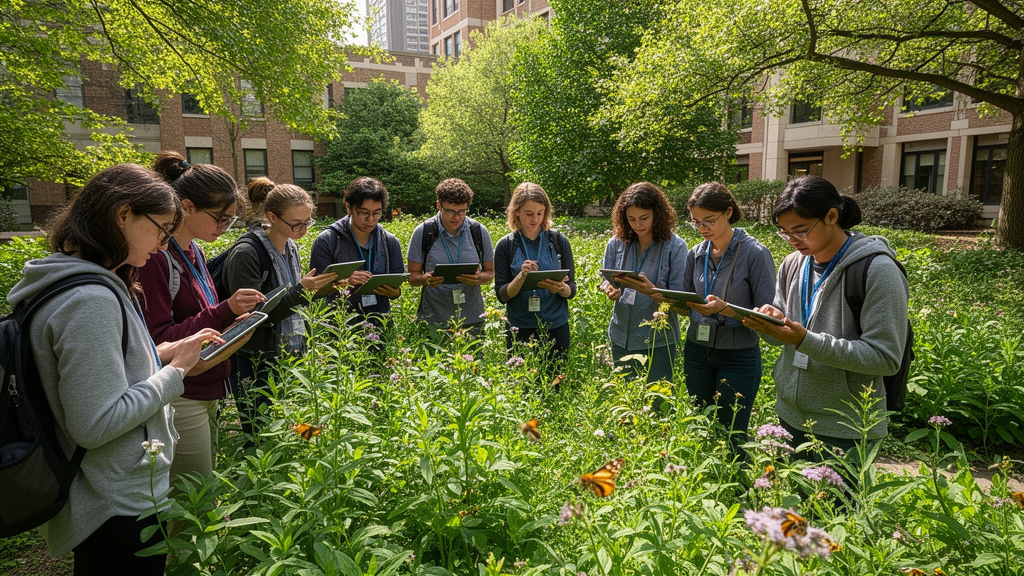
Over its three-year operating period, the project generated a modular suite of educational resources and pedagogical materials that have now been released to the wider educational community. These outputs include a standardized competency framework, an indexed repository of teaching methodologies, a specialized training toolkit, and a dedicated online learning environment accessible through the official project platform. In parallel, the consortium explored the practical application of urban observatories and municipal laboratories, identifying them as experiential learning environments where students and instructors can systematically monitor and observe urban biodiversity dynamics in real time.
In Spain, the initiative carried out applied analytical work, including a comparative assessment comparing Zaragoza's Green Infrastructure Master Plan with analogous urban strategy documents across several European cities. The consortium also convened an applied workshop dedicated to biodiversity-focused urban planning models for Madrid, coordinated by Professor José María Ezquiaga, president of AETU and recipient of national and European urban planning honors. These activities directly connected classroom theory with local environmental governance, offering practical field relevance for students in geography, spatial planning, architecture, urbanism, and environmental sciences at the University of Zaragoza as the city prepares for its designation as European Green Capital for 2028.
Subject of Research: Higher education methodologies and educational resources for urban biodiversity and spatial planning
Article Title: European U.BI.TEACH project concludes after three years of research into urban biodiversity education
Article References: European U.BI.TEACH project concludes after three years of research into urban biodiversity education. Original publication (Bibliographic details unavailable.)
Image Credits: AI Generated
DOI: Not provided
Keywords: U.BI.TEACH, urban biodiversity, higher education, Erasmus+, University of Zaragoza, nature-based solutions, urban heat islands, spatial planning, bioclimatic planning, urban regeneration, UN-Habitat New Urban Agenda, content analysis, competency framework, urban observatories, Green Infrastructure Master Plan, European Green Capital 2028, Spanish Association of Urban Planners, sustainability education