Opinion | College Students Can't Understand Dickens. Is That a Bad Thing?


The OER Observatory aggregates and displays OER-related news and content from third-party sources worldwide. This content is not produced by UNESCO or the OER Dynamic Coalition. All rights and responsibility for the original content remain with the respective authors and publishers. The inclusion of third-party content in the Observatory does not imply endorsement by UNESCO or the OER Dynamic Coalition. Users can access the original source through the link provided with each item.
A free account provides you access to a limited number of free articles each month, plus newsletters, job postings, salary data, and exclusive store discounts.
What does it mean to understand what you read? In March 2024, The CEA Critic, the scholarly journal of the College English Association, published an article about U.S. English and English education majors who could not understand the first seven paragraphs of Charles Dickens's Bleak House. Entitled "They Don't Read Very Well: A Study of the Reading Comprehension Skills of English Majors at Two Midwestern Universities," the study used a "think-aloud" method in which students read a text and then explain what they think it means in their own words. "These verbalizations," the authors note, "can provide a measure of the actual cognitive processes readers engage in during comprehension." They chose Bleak House for its complex sentences and frequent movement from literal to figurative meanings, and because the novel is "a standard in college literature classes."
Only 5 percent of readers, according to the CEA study, exhibited "a detailed, literal understanding" of the first paragraphs of Bleak House. These students were able to figure out that the Lord High Chancellor, "with a foggy glory round his head, softly fenced in with crimson cloth and curtains, addressed by a large advocate with great whiskers, a little voice, and an interminable brief, and outwardly directing his contemplation to the lantern in the roof, where he can see nothing but fog," was a judge and that the scene was a court of law. They also recognized the effect of the repeated patterns of "fog" and "mud," and came to the novel with enough historical knowledge to see Dickens was describing 19th-century urban pollution. Thirty-eight percent, the "competent" readers, could understand some of Dickens's vocabulary and figures of speech, but they became easily tired and resorted to loose hunches, frequently skipping over unfamiliar words like "implacable."
The majority -- 58 percent -- were categorized as "problematic" readers. These students could understand very little of Bleak House: They could not take in "concrete detail in consecutive clauses and phrases" or "link the meaning of one sentence to the next." The strategies these readers used were oversimplifying, guessing, and commenting. One subject explained that she separated reading from thinking: "I'm just reading it; I'm not thinking about it yet." Another student wrote: "I normally don't try to analyze individual sentences as I'm reading something. I try to look at the overall bigger picture of what's going on." Students who relied on this strategy "became more and more lost" as they continued to read the passage. Nevertheless, all the problematic readers were sure they could finish Bleak House with the help of SparkNotes, Google, or Wikipedia. As one student said, "If I was to read this by itself and didn't use anything like that, I don't think I would actually understand what's going on 100 percent of the time."
In blogs and Reddit posts, Substack essays and a recent piece in The Atlantic, people reacted to the Kansas study with shock. Many people found it especially disturbing that the students in the test group were English majors who intended to teach English professionally, at the high-school level. Some wondered how these young people would manage to talk to teenagers about Shakespeare and Dickens if they struggled to read a novel such as Bleak House without relying on SparkNotes. I agree that the results of the study are dismaying, though the test groups were from just two regional Kansas universities and the researchers tested only 85 subjects -- a very small sample size. The subjects came to college with an average ACT Reading score of 22.4. According to the Educational Testing Service, they were reading on a "low-intermediate level," so "the majority of this group did not enter college with the proficient prose-reading level necessary to read Bleak House or similar texts in the literary canon."
I should also note that, though the article was published in CEA Critic in 2024, the test took place from January to April 2015 -- well before the invasion of artificial intelligence into our classrooms and before the disruptions of Covid. That means these college students, who could not read the first seven paragraphs of Bleak House, are now nearing the age of 30, citizens of the busy world, perhaps with families of their own. Maybe they are, indeed, plying their trade in high-school English classrooms today.
That prospect does not alarm me. The metrics the study produced cannot be generalized to include most English majors, and they cannot tell the whole story about those particular students' relationship to literature or their dedication to teaching English. Even back in 2015, the Kansas students probably knew more than they thought they knew about reading Bleak House or any difficult piece of literature. One thing they knew for certain is that a literary work does not deliver up its secrets in any kind of straightforward way. A lot goes over our heads, even the heads of the best readers. In a short book titled On Literature, J. Hillis Miller argued that it is important that we remember literature's essential strangeness. So much formal literary study, Miller complained, "has always had as one of its main functions covering that strangeness over." Consider, in this light, the opening of Bleak House:
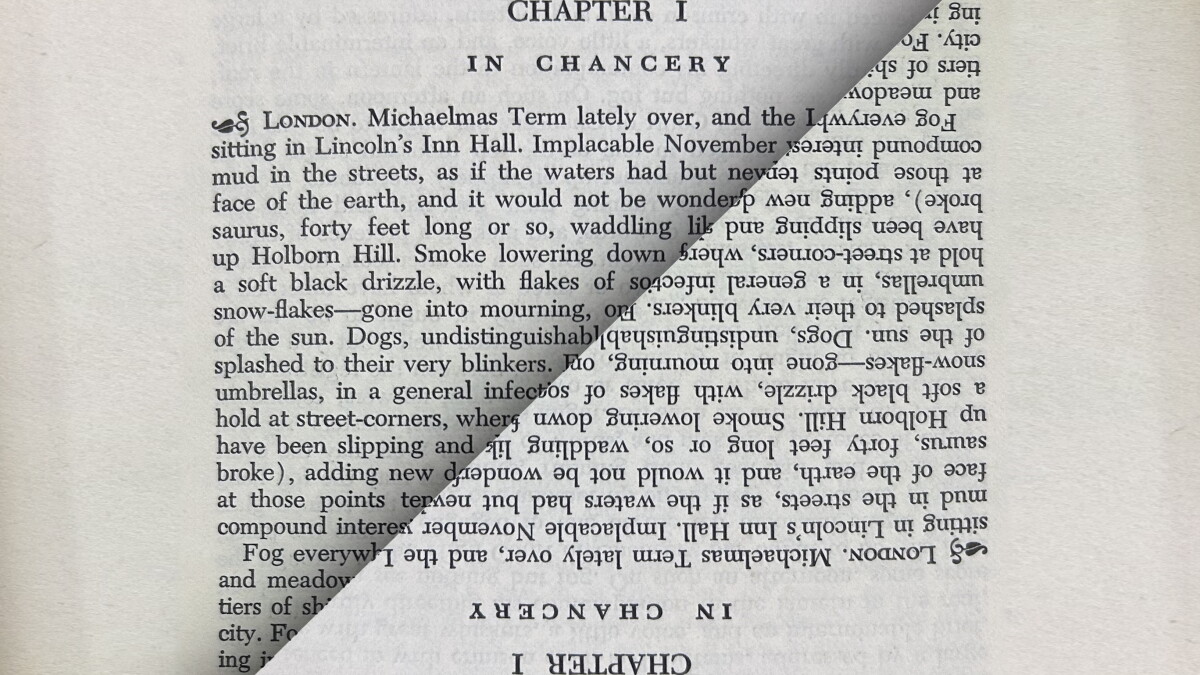
London. Michaelmas term lately over, and the Lord Chancellor sitting in Lincoln's Inn Hall. Implacable November weather. As much mud in the streets as if the waters had but newly retired from the face of the earth, and it would not be wonderful to meet a Megalosaurus, forty feet long or so, waddling like an elephantine lizard up Holborn Hill.
We pretend that this bizarre and brilliant passage can be settled by talking to students about the squalor of London in the wake of the Industrial Revolution, or the impact of Darwinism and paleontology on Victorian readers accustomed to Biblical narratives of the earth's creation. But does that really help us get at what makes it so effective? What about the clipped and definitive sentences followed by the snaking, sludging, trudging sentence? And the image that Dickens goes on to conjure of a modern metropolis that is at once manically in motion ("Foot passengers, jostling one another's umbrellas in a general infection of ill temper, and losing their foothold at street corners, where tens of thousands of other foot passengers have been slipping and sliding since the day broke") and at the same time mired in mud and frozen in fog?
The Kansas students could not understand the meaning of Dickens's sentences, and what we teach our students is to get the text right. The authors of the CEA study note that even the competent readers "would define words incorrectly and ... skip words they did not understand. Essentially, they were comfortable with their confusion." (One student, befuddled by the description of the Lord High Chancellor in his chambers, guessed that "a large advocate with great whiskers" referred to a cat.)
But isn't it possible that, even if students get the first seven paragraphs of Bleak House "wrong" -- because they have no idea what "Michaelmas" and "Chancery" mean, or they have never seen the word "implacable" -- they may still be feeling the right way about it? Bleak House could provoke a certain quality of experience for them, and they could learn how to think about and even describe that experience. They could imagine the experience of being confused, in a fog, about Bleak House as similar to the experience of living in a historical situation that is fairly hostile to individual desires or is dominated by waste and injustice. Maybe getting comfortable with confusion is actually the right way to read Bleak House?
There are many uneducated and illiterate people in Dickens's fiction. He very often presents them as having special knowledge that is unavailable to the overconfident intellectuals who are invested in maintaining their authority. "Dickens consistently juxtaposed verbal people, whose language thwarts genuine feeling and disguises moral reality, with inarticulate people, whose gestures or simplicity of statement penetrates the obscurity of surfaces," the critic George Levine has observed. The Kansas study's "think-aloud" method privileges verbalization by asking students to explain to a moderator what they took from the text immediately after reading it. They want to see, basically, if students "get it." But does being able to verbalize something out loud mean that you got it? And does being unable to mean that you didn't?
It's not surprising that the words "comprehend" and "comprehension" are used 24 times in the CEA article. The word comes from the Latin root for "seize" and is described as a noun of action. But in Dickens, true comprehension is more often a scene of passivity, or even confusion. In many of his major novels -- Bleak House, Great Expectations, Little Dorrit, Our Mutual Friend, David Copperfield -- characters come to important realizations about their lives only after mental effort has been forced into abeyance and they feel lost. David Copperfield, unmanned by grief and wandering the continent, happens one evening to see a bright cloud floating across the Alps. The "shifting quicksands of my mind," he says, began slowly to clear. He realizes his love for Agnes, and he finds the strength to write again with purpose. Pip only understands Joe's loyalty and his wretched ingratitude after he has been in a fever for days: "For the tenderness of Joe was so beautifully proportioned to my need, that I was like a child in his hands." Esther Summerson only parts with her "little secret," that she loves Allan Woodcourt, after weeks of incoherent dreams when she has the smallpox. The seizing mind needs to switch off for understanding to find a resting place. In Dickens, genuine comprehension is often a reversal in direction, a movement backwards, away from a mundane knowledge of outward things toward another kind of knowing. "I don't know anything," cries Scrooge joyfully after he has been visited by the three spirits. From being "a squeezing, wrenching, grasping, scraping, clutching, covetous, old sinner," he has become "quite a baby. Never mind," he says. "I don't care. I'd rather be a baby." Those words launch his moral redemption.
How do you measure who is a "problematic" or "competent" reader of Dickens, or of any author? The Kansas undergraduate who paused in his reading of Bleak House to look up "Michaelmas" on his phone may have had the right intuition -- it's really no different than stopping to read a footnote in a Norton edition, when you think about it. At the same time, I identify with the student who just kept turning the page even when she didn't get it ("I'm just reading it; I'm not thinking about it yet"). Perhaps she did not want to break her contact with the narrator's voice just to satisfy a desire to know what "Chancery" refers to. To approach the question of who is a competent reader of Bleak House, we first need to ask what any reader is reading it for -- and what any teacher is teaching it for.
If I had to teach Bleak House to a class of undergraduates tomorrow, I am not sure I would know where to begin. In the last two decades, I've been encouraged to incorporate digital tools into my literature courses, to fold in proficiency-based learning experiences, to consider community outreach and public-facing activities, and to experiment with non-essay assignments and hands-on projects. Faculty at my institution who conform to these expectations are rewarded with course-development grants for "instructional innovation," "accelerating creative teaching," and using open educational resources (OER). There is nothing wrong with any of this. To ensure our survival, teachers in the humanities have always had to modernize and adapt, and there are now endless opportunities to make sure everyone gets it all the time.
The stakes are real -- and they are, at least partially, economic. "Why is proficient prose literacy so important?" the authors of the Bleak House study ask, rhetorically. "Why does the ability to read complex texts matter if college students can still graduate with good grades, find employment, and earn entry into graduate schools?" It matters, they write, because "long-term studies reveal that lower literacy skills affect college graduates throughout their professional careers. ... According to an ETS report, students 'with the highest literacy skills will make 38 percent more a month than other college graduates.'" Thirty-eight percent more a month! That statistic is not insignificant. But it is not exactly why I teach Bleak House.
After almost 40 years in academe, I am nearing the end of my teaching career. My retreat from innovation for innovation's sake has been a long time coming -- farewell PowerPoint, and good riddance -- though now it is driven largely by having to circumvent AI and other technologies that erode the trust between teacher and student. But I have also been feeling the mounting importance of letting students connect with whatever they respond to in what we're reading, to let go of my agenda for the class and the need to elucidate every context, every reference. Reading literature is intellectually difficult and emotionally challenging. The whole process is wonderfully elusive, the flashes of insight so delightfully fugitive -- I wish we talked more to our students about how much slips through our fingers when we read, and that is as it should be. For we are engaging with works of the human imagination, not with bureaucratic documents or chunks of data. Art makes its way to meaning through suggestion, resonance, just-out-of-reachness, strangeness.
Maybe we're hesitant to admit that there are many things about literature that are too weird to be reasoned with and that escape the critical eye. "A list of the vices of reading should put first, as worst and most disabling, the expectation that everything should be easily understood," the critic I.A. Richards wrote in 1942. "Things worth thought and reflection cannot be taken in at a glance." Can we teach students -- and model for them -- the essential uncanniness and inscrutability of great literature? Can we admit to ourselves that half the time maybe we aren't getting it either? It's good to be reminded now and then of the peculiarity of our undertaking as teachers of literature -- and to celebrate the ways literary language keeps us off balance, awakens and surprises us into attention. An English class should remind us that, when we read literature, something besides cognition may be steering the ship.
One summer when I was about 16, I picked up Virginia Woolf's Mrs. Dalloway. The book belonged to my much older brother who was studying for a doctorate in German literature. When he walked into the room and saw what I was reading, he laughed. "You won't understand that," he snorted. I was indignant. But of course, he was right. I didn't understand Mrs. Dalloway. How could I? I knew nothing about modernism and British literary history. All I knew was that Virginia Woolf was an important writer, and so I wanted to experience that book. And who knows? Maybe something seeped in, even if it was only a sentence that washed over me and left a tiny imprint. I didn't know anything at that age (as my brother often reminded me) except that there was a whole world of books out there that I longed to read. Wasn't that desire, too, a kind of knowing?