The Global Internet: Ubiquity, Inequality, and the Early History of a Connected World.


The OER Observatory aggregates and displays OER-related news and content from third-party sources worldwide. This content is not produced by UNESCO or the OER Dynamic Coalition. All rights and responsibility for the original content remain with the respective authors and publishers. The inclusion of third-party content in the Observatory does not imply endorsement by UNESCO or the OER Dynamic Coalition. Users can access the original source through the link provided with each item.
The Global Internet: Ubiquity, Inequality, and the Early History of a Connected World.
The Global Internet: Ubiquity, Inequality, and the Early History of a Connected World
A data-driven examination of who is online, who is not, and why the internet's biggest transformations may still be ahead of us.
1. Introduction & The Illusion of Ubiquity
If you are reading this on a laptop or a phone, you belong to a specific and historically unusual slice of humanity -- one whose entire day is scaffolded by connectivity. An alarm synced to the cloud wakes you. A weather app tells you whether to bring an umbrella. A mapping service routes you around traffic before you have even started the car. Emails, calendar invites, group chats, and streaming queues arrive continuously, all day, without you ever consciously "logging on," because for people in this world, there is no meaningful moment of logging on at all. Connectivity is ambient. It has become as unremarkable as electricity or running water.
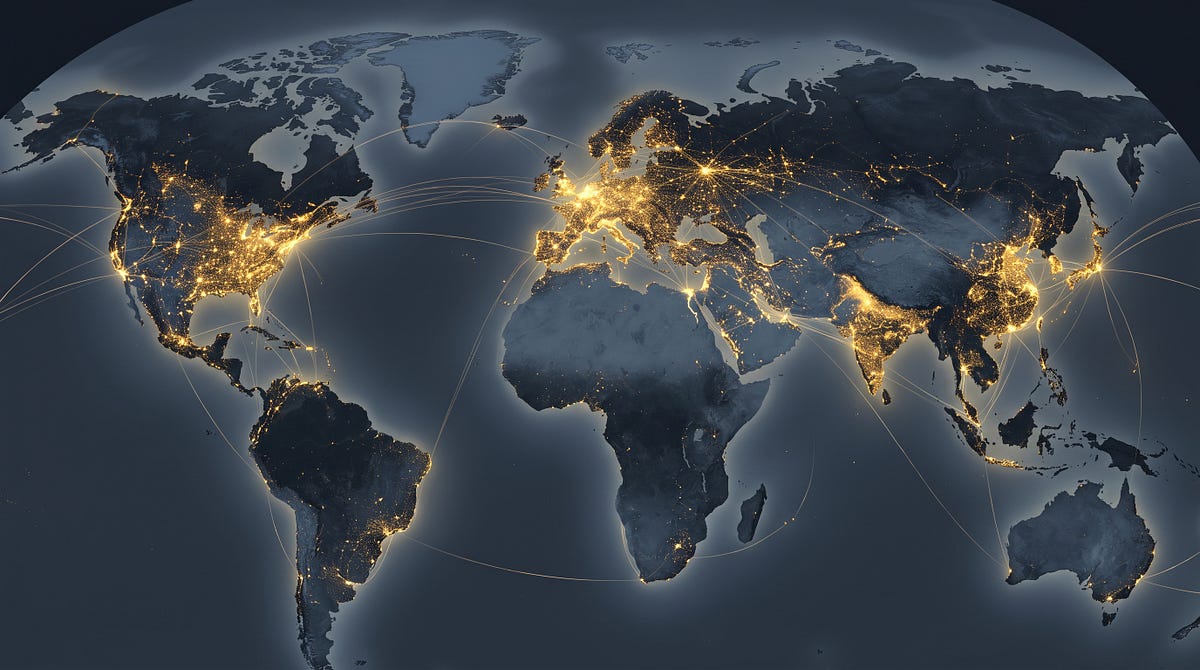
This experience produces a powerful cognitive illusion: the sense that the internet is now simply a universal feature of modern life, something that has already finished happening. It has not. According to International Telecommunication Union (ITU) estimates compiled with the World Bank, roughly 26-27% of the world's population -- a figure in the neighborhood of 2.1 to 2.2 billion people -- had not used the internet as of 2026. That is a smaller share than it was just a few years earlier (offline populations were closer to 35-37% of the world as recently as 2022-2023), but it still represents more people than lived on Earth in the year 1930. The digital divide has narrowed considerably faster than most forecasters expected mid-decade, yet it remains one of the largest unresolved gaps in access to a general-purpose technology in human history.
The contrast in lived experience is stark. The average internet user worldwide now spends around six-and-a-half to nearly seven hours online per day -- closer to eight or nine hours in some heavily-connected markets -- while thereumaining offline population experiences zero minutes of digital life: no search engines, no maps, no instant translation, no telemedicine, no digital banking, no access to the accumulated knowledge of Wikipedia or the pricing information that lets a farmer compare crop prices across markets. These are not two ends of a spectrum of internet intensity; they are two entirely different informational universes coexisting on the same planet at the same time.
Chart Callout Box Title: Share of the Population Using the Internet, by Country Subtitle: Interactive world map showing internet penetration rates from under 5% to near-universal access Data Source: World Telecommunication/ICT Indicators Database, International Telecommunication Union (ITU), via World Bank Metric: Individuals using the Internet (% of population) Visualization Type: Choropleth world map, single-year slider (1990-2026) Key Takeaway: Internet access ranges from near-total saturation (95%+) across Northern and Western Europe, the Gulf states, and North America to below 15% in a small cluster of low-income and conflict-affected states, with the steepest remaining gaps concentrated in Sub-Saharan Africa and parts of Southern Asia.
Regional Connectivity Snapshot (2026)
RegionInternet PenetrationApprox. Offline Population ShareNotesNorthern Europe~97.7%~2.3%Highest in the world; near-universal in Netherlands, Norway, IcelandWestern Europe~95-96%~4-5%Mature fixed and mobile infrastructureNorth America~93.1%~6.9%US: ~324 million usersGulf States (GCC)~95%+<5%High per-capita income, dense urban populationsEast Asia~75%~25%China alone: ~1.3 billion users, ~91.6% penetrationLatin America & Caribbean~83-84%~16%Urban connectivity far outpaces rural areasSouthern Asia~64-66%~34-36%India: ~440 million people still offlineMiddle East / Western Asia~76%~24%Wide variance between Gulf states and conflict zonesSub-Saharan Africa (avg.)~35-38%~62-65%East Africa penetration near 29%World~73-74%~26-27%~6.1 billion internet users globally
The takeaway from this table is not simply "rich countries are online and poor countries are not." It is that the remaining offline population is now heavily concentrated -- geographically, economically, and demographically -- in specific corridors: rural Sub-Saharan Africa, rural Southern Asia, and low-income, often landlocked or conflict-affected states elsewhere. The last mile of global connectivity is not a diffuse global problem anymore; it is an increasingly localized one.
2. Three Decades of Exponential Expansion (1990-Present)
The internet's journey from a niche research tool to a everyday utility for six billion people did not happen at a constant pace. It moved in distinct phases, each defined by a different technological bottleneck and a different set of adopters.
Phase 1: Early Adoption & Academic Roots (1990-1999)
At the dawn of the 1990s, the internet was barely a public phenomenon at all. Global penetration was a fraction of one percent, concentrated among university researchers, government labs, and a small population of hobbyists connecting over dial-up modems that screeched and crawled at speeds measured in kilobits per second. The defining infrastructure of this era -- the protocols (TCP/IP), the naming system (DNS), and eventually the World Wide Web itself (1991) -- was built by academics and engineers, not consumer companies. By 1999, global internet penetration had climbed to roughly 4-5% of the world's population, still an overwhelmingly North American and Western European phenomenon.
Phase 2: Initial Commercial Growth (2000-2009)
The dot-com crash of 2000-2001 is often remembered as the internet's first major setback, but the underlying user base kept growing throughout the decade. Broadband began displacing dial-up in wealthy economies, transforming the internet from an occasional, deliberate activity ("going online") into a persistent household connection. The rise of "Web 2.0" -- user-generated content, social networking (Friendster, MySpace, and later Facebook), and video (YouTube, launched 2005) -- gave ordinary users, not just technologists, a reason to stay connected. By the end of the decade, global penetration had reached roughly 25-30%, with the fastest growth increasingly occurring outside the traditional early-adopter economies.
Phase 3: The Mobile & Global Expansion Era (2010-2020)
This is the decade in which the internet stopped being primarily a Western, desktop-bound phenomenon and became a genuinely global, mobile one. The proliferation of 3G and then 4G networks, combined with the collapse in prices of smartphones, allowed hundreds of millions of people in Asia, Latin America, and Africa to connect to the internet for the first time -- often without ever owning a desktop computer or a fixed telephone line. Global penetration roughly doubled over this period, climbing from around 30% in 2010 to nearly 60% by 2020. India and China alone added over a billion combined users during this decade.
Phase 4: Billions Online & the Post-Pandemic Normal (2021-Present)
The COVID-19 pandemic accelerated digital adoption across nearly every remaining offline demographic -- remote schooling, telemedicine, and remote work pulled reluctant late adopters online out of necessity. Growth continued through the mid-2020s, and the world crossed the six-billion-user threshold in early-to-mid 2026, representing roughly 73-74% of the global population. Annual growth has slowed in relative terms (roughly 1% year-over-year as of 2026), not because interest is fading, but because the remaining unconnected population is disproportionately rural, low-income, and harder to reach with existing infrastructure economics.
1990-1999Academic &Research RootsDial-up modems~1% globalpenetration (1995)~4-5% globalpenetration (1999)2000-2009Dot-com ReboundBroadbandemergenceWeb 2.0 & socialnetworking~25-30% globalpenetration (2009)2010-2020Mobile & GlobalExpansion3G/4G proliferationLow-costsmartphones~60% globalpenetration (2020)2021-2026Billions OnlinePost-pandemicacceleration6 billion usersreached (2026)~73-74% globalpenetrationGlobal Internet Adoption: Four Phases (1990-2026)
The Geographical Center of Gravity Has Shifted
In the 1990s, the internet's user base was overwhelmingly North American and Western European. That is no longer remotely true. By 2026, Asia alone accounts for well over half of the world's internet users -- roughly 58-59% of the global total -- with East Asia (China, Japan, South Korea) and Southern Asia (India, Pakistan, Bangladesh) together housing more internet users than the rest of the world combined.
RegionApprox. Internet Users (millions, latest available)Approx. Share of World TotalEast Asia~1,340+~22%Southern Asia~1,195+~20%Americas (combined)~865~14%Southeast Asia~560~9%North America~475~8%South America~320~5%Europe (combined subregions)~715~12%Western Asia / Middle East~200~3%Africa (combined subregions)~575~9%
Two decades ago, a chart like this would have shown North America and Europe accounting for the majority of users. Today, a single country -- India -- has more internet users than the entire population of Europe, and China's connected population alone roughly equals that of North and South America combined. The "typical" internet user today is not a resident of a wealthy Western economy; increasingly, they are a mobile-first user in South or East Asia. Any discussion of "the internet" that implicitly centers a Western experience risks badly misdescribing the network as it actually exists in 2026.
3. The Infrastructure Paradox & Technological Leapfrogging
One of the internet's least intuitive features is that the path most high-income countries took to get everyone connected -- first fixed telephone lines, then fixed broadband, then mobile as a supplement -- has simply not been replicated in most of the developing world. Instead, huge swaths of the global population have skipped that sequence entirely.
Why Fixed-Line Infrastructure Didn't Scale Globally
Fixed broadband -- cable, DSL, and fiber run into individual homes -- requires enormous upfront capital expenditure: trenching, laying physical cable, connecting individual buildings, and maintaining that infrastructure against weather, theft, and decay. In dense, wealthy cities this cost is spread across a huge number of paying subscribers, making the economics work. In rural or lower-income regions, the same infrastructure has to cover far more physical distance per potential subscriber, while incomes are lower and rights-of-way, land tenure, and regulatory permitting are frequently more complicated. The result: as of the mid-2020s, high-income countries average around 39 fixed-broadband subscriptions per 100 people, while low-income countries average under 1 (roughly 0.6 per 100 people) -- a gap of more than 60-fold.
Mobile-First Realities
Cellular infrastructure solves this problem in a fundamentally different way. A single cell tower can serve a wide radius without the need for physical wiring to every individual household, dramatically lowering the capital cost of reaching a given population. Combined with the collapse in smartphone prices over the 2010s (driven substantially by manufacturers in China and India producing sub-$50 devices), this made mobile networks the default, and often the only, way that people in developing regions have ever accessed the internet. Many users in Sub-Saharan Africa, Southern Asia, and parts of Latin America have never owned a landline telephone or a fixed broadband subscription at all -- they moved directly from "no connectivity" to "mobile internet," skipping the intermediate technological stages that defined connectivity's rollout in Europe and North America decades earlier. Globally, mobile-cellular subscriptions now exceed 9 billion -- more than the human population -- reflecting multiple SIM ownership in some markets, and roughly 99 mobile-broadband subscriptions exist per 100 people worldwide, dwarfing fixed broadband's global average.
Subscriptions per 100 People, by Income Group
Income GroupFixed-Broadband Subscriptions (per 100)Mobile-Cellular Subscriptions (per 100)Mobile-Broadband Share of Mobile SubscriptionsHigh Income~39~142~90%+Upper-Middle Income~18-22~110-120~85-90%Lower-Middle Income~3-6~90-100~75-85%Low Income~0.6~70~55-65%World Average~17-18~112~89%
The gap in mobile connectivity between rich and poor countries (roughly 2x) is far smaller than the gap in fixed connectivity (roughly 60x or more). This is the essence of technological leapfrogging: rather than replicating the capital-intensive, decades-long buildout that wealthy nations pursued, lower-income regions adopted a cheaper, faster-to-deploy technology that partially substitutes for the old one -- arriving at "internet access," even if not at the same speed, reliability, or cost per gigabyte, through an entirely different infrastructure path.
Leapfrogging Path (Emerging Markets, 21st Century)Legacy Path (High-Income, 20th Century)Decades to matureSingle generation, fasterrolloutFixed Telephone Lines(1900s-1980s)Dial-up Internet(1990s)Fixed Broadband:DSL/Cable/Fiber(2000s-2010s)Home Wi-Fi + Mobile asSupplementNo Fixed TelephoneInfrastructureCellular Base Stations(2G, mid-2000s)3G / 4G Mobile Broadband(2010s)Low-Cost Smartphone asPrimary/Only DeviceHousehold Connected
This leapfrogging has real consequences beyond speed of adoption. Because so much of the developing world's internet access runs through mobile data plans rather than flat-rate home broadband, the marginal cost of using the internet stays high for hundreds of millions of users, even after they technically have "access." In the Central African Republic, for example, the cheapest available cellular data plan can cost more than a quarter of the average person's monthly income -- a level of expense that would be unthinkable in a high-income market, and one that shapes not just whether people go online, but how much and how often.
4. The Dual Nature of the Internet: Essential Utility vs. Social Media Saturation
The internet is not one thing. It is simultaneously a piece of critical infrastructure -- comparable to electricity, roads, or postal systems -- and a platform for entertainment and social interaction whose economic model runs on advertising and attention. These two identities coexist uneasily, and most public debate about "the internet's effects on society" conflates them.
The Essential Utility Layer
For a migrant worker sending money home, the internet has functionally lowered the cost of remittances, cutting out layers of intermediary fees that once ate into transfers sent through traditional money-transfer operators, and giving low-income families faster, cheaper access to funds that support food, school fees, and medical costs. For a student in a location without a nearby university, online courses and open educational resources provide a form of access to instruction that simply did not exist a generation ago. For scientists, the internet enables collaboration across continents in real time -- shared datasets, video conferencing, and preprint servers have measurably accelerated the pace at which research circulates, a dynamic made especially visible during the COVID-19 pandemic when genomic sequences and clinical trial data moved across the globe within hours. And in disaster response, internet and mobile connectivity now serve as some of the first channels through which warnings are issued and aid is coordinated, often faster than traditional broadcast media can reach affected populations.
The Social Media Dominance Layer
At the same time, for a large share of daily internet users, "the internet" in practice means a small number of algorithmically curated social platforms. Estimates suggest that a substantial majority of active internet users -- often cited around two-thirds or more -- spend the bulk of their online time on a handful of social media and video platforms rather than the open, decentralized web that early internet architects envisioned. This has produced what some researchers describe as a bifurcation between the "open web" (independent websites, blogs, forums, and protocols anyone can build on) and the "corporate internet" (a small number of platforms that mediate discovery, attention, and monetization for most users). The economic incentives of the latter are built around maximizing time-on-platform, which is a very different design goal than maximizing user benefit or informational value.
DimensionEssential Web Utility Use CasesAlgorithmic Media ConsumptionPrimary PurposeInformation access, transactions, coordinationEntertainment, social validation, attention captureExample ActivitiesBanking, remittances, telemedicine, e-learning, government services, disaster alertsShort-form video, social feeds, algorithmic recommendation streamsEconomic ModelOften subscription, fee-for-service, or public-sector fundedOverwhelmingly advertising-fundedDesign IncentiveTask completion, efficiency, accuracyTime-on-platform, engagement, session lengthTypical User RelationshipDeliberate, goal-directed, infrequentHabitual, algorithmically prompted, frequentOffline-Population Impact if ConnectedHigh potential welfare gain (financial inclusion, health, education)Ambiguous; gains in social connection offset by attention and mental-health costs
The Public Health & Well-Being Debate
No discussion of the internet's social effects would be complete without acknowledging the extensive, and still unsettled, research literature on social media and mental health, particularly among adolescents. Some studies find modest but statistically significant associations between heavy social media use and indicators of anxiety, depression, and poor sleep, particularly among teenage girls. Other researchers caution that the average effect sizes found across large population studies are small, that correlation is frequently mistaken for causation in this literature, and that aggregate "screen time" is a crude proxy that obscures very different experiences -- passive scrolling through comparison-inducing content differs meaningfully from active messaging with friends, or from time spent learning a skill via video.
Several more specific mechanisms have been proposed as plausible causal pathways rather than as settled conclusions: social comparison dynamics amplified by curated, idealized self-presentation; displacement of sleep due to late-night device use; exposure to cyberbullying and harassment at a scale unavailable before networked platforms; and algorithmic content sorting that can create echo chambers or repeatedly surface emotionally activating material because it drives engagement. Distinguishing which of these mechanisms carries meaningful causal weight, for which populations, and under what conditions, remains an active area of ongoing empirical research rather than a solved question -- and readers should treat sweeping claims in either direction (that social media is definitively "rewiring" a generation's brains, or that concerns about it are simply moral panic) with appropriate skepticism.
Chart Specification Callout Box Title: Share of Internet Users Who Are Active Social Media Users Subtitle: Comparing platform-mediated engagement against total internet population, by region Data Source: DataReportal Digital Global Overview; GSMA Mobile Economy Reports Metric: Active social media identities as % of total internet users Visualization Type: Stacked bar chart by region, with a global average reference line Key Takeaway: In most regions, a majority of internet users maintain at least one active social media account, but usage intensity -- measured in hours per day -- varies far more than adoption itself, with the highest averages recorded outside the wealthiest economies.
5. A History Just Begun: The Infancy of Digital Civilization
It is tempting, from inside a fully saturated digital environment, to think of the internet as a mature technology whose major disruptions are behind us. Historical comparison suggests the opposite conclusion.
Consider the movable-type printing press, introduced in Europe in the mid-15th century. Its most consequential downstream effects -- the Reformation, the scientific revolution, mass literacy, the emergence of a public sphere shaped by widely circulated texts -- did not fully unfold for a century or more after Gutenberg's press began operating. The printing press did not simply make existing books cheaper; it restructured how knowledge moved through society, who could access it, and who could challenge established authorities, and those effects took generations to work themselves out.
The steam engine offers a similar lesson. Early steam engines were used for narrow industrial applications -- pumping water out of mines -- for decades before the technology matured enough to power railways and reorganize the geography of trade, labor, and urban life. The full transformation associated with industrial mechanization unfolded over more than a century, not within the lifetime of the engine's original inventors.
The telecommunications grid and the automobile followed comparable arcs: both required decades of complementary infrastructure investment -- telephone exchanges and cabling in one case, paved roads, fuel distribution, and urban redesign in the other -- before their transformative social effects became visible at scale.
Timeline of Transformative Technologies: Invention vs. Societal Maturation
========================================================================
Printing Press |=====| invention
(c. 1440) \_____________________________/ full societal effects
(100-150+ years)Steam Engine |==| invention (pumping, narrow use)
(c. 1712) \_____________________/ railways, industrial reorg
(~100 years)Telecom Grid |=| invention (telegraph/telephone)
(c. 1870s) \______________________/ mass adoption + effects
(~70-80 years)Automobile |=| invention
(c. 1886) \___________________/ mass adoption + effects
(~50-60 years)Internet |=| invention/early adoption
(c. 1990s) \___/ <- we are here (~30-35 years)
Full societal effects: still unfolding
The internet is, by this standard, extraordinarily young -- roughly three decades into public existence, and barely two decades into genuinely global, mobile-first adoption. As Our World in Data founder Max Roser has put it, in a formulation that captures the core argument of this piece: the internet has already changed the world, but the big changes it will bring still lie ahead. If the pattern established by prior general-purpose technologies holds, the internet's largest social, economic, and political effects are not behind us in the 2000s and 2010s -- they are still ahead, likely unfolding over the remainder of this century as usage matures, complementary institutions adapt, and -- critically -- as the remaining offline population joins the network.
What Happens When the Remaining Offline Population Logs On?
The roughly 2.1-2.2 billion people who remain offline today are not a static or peripheral group; they represent close to a third of humanity, concentrated disproportionately among rural populations, low-income households, and -- within those groups -- women, who face a persistent "mobile gender gap" in access across South Asia and Sub-Saharan Africa. Connecting this population is not merely a matter of extending an existing experience to more people; it will very plausibly reshape the internet itself.
Economically, hundreds of millions of new participants in digital marketplaces, mobile banking, and e-commerce could accelerate financial inclusion in regions where traditional banking infrastructure never reached. Culturally and linguistically, the internet today remains skewed toward a relatively small number of dominant languages online relative to the linguistic diversity of humanity; as new populations come online, demand for content, interfaces, and AI tools in underrepresented languages is likely to grow substantially, reshaping what "the internet" contains and who it serves. Politically, expanding connectivity has historically been double-edged -- simultaneously enabling civic organizing and independent journalism, while also expanding the reach of surveillance and disinformation; the effects of the next wave of adoption on political systems in currently under-connected regions are genuinely uncertain and will depend heavily on governance choices made now, not on the technology itself.
Final Synthesis: Digital Equity, Infrastructure Policy, and Long-Term Stewardship
Three implications follow from treating the internet as an early-stage, not a mature, technology.
First, closing the remaining connectivity gap deserves to be treated as a first-order development priority, comparable historically to electrification or clean water access, rather than as a secondary concern behind traditional development metrics -- because digital access is increasingly a precondition for participating in education, finance, and civic life, not merely a convenience layered on top of them.
Second, the infrastructure path that connects the final quarter of humanity will differ substantially from the path that connected the first three-quarters; policy and investment should be designed around mobile-first, low-cost, and shared-access models rather than assuming a fixed-broadband buildout that has already proven economically unworkable in the lowest-income regions.
Third, the questions currently being debated about social media, algorithmic content, and mental health should be understood as early data points in a much longer institutional adjustment process -- the printing press was followed by libraries, copyright law, and journalistic norms that took generations to develop; the internet's own complementary institutions, whether in platform design, digital literacy education, or regulation, are still being built, tested, and revised in real time.
The internet is not a finished story about universal access that the rest of the world is slowly catching up to. It is an unfinished, unevenly distributed, still-rapidly-changing technology whose most consequential chapters -- for the newly connected and the already connected alike -- are very likely still ahead.
Craving real results without the grind? The Smoothie Diet blends fresh, delicious recipes into a simple 21-day plan that torches fat, boosts energy, and fits any lifestyle. No starving, no complicated cooking -- just sip, savor, and watch the transformation. Your best body starts in a blender!