 News
News
From fragmented policies to open knowledge ecosystems


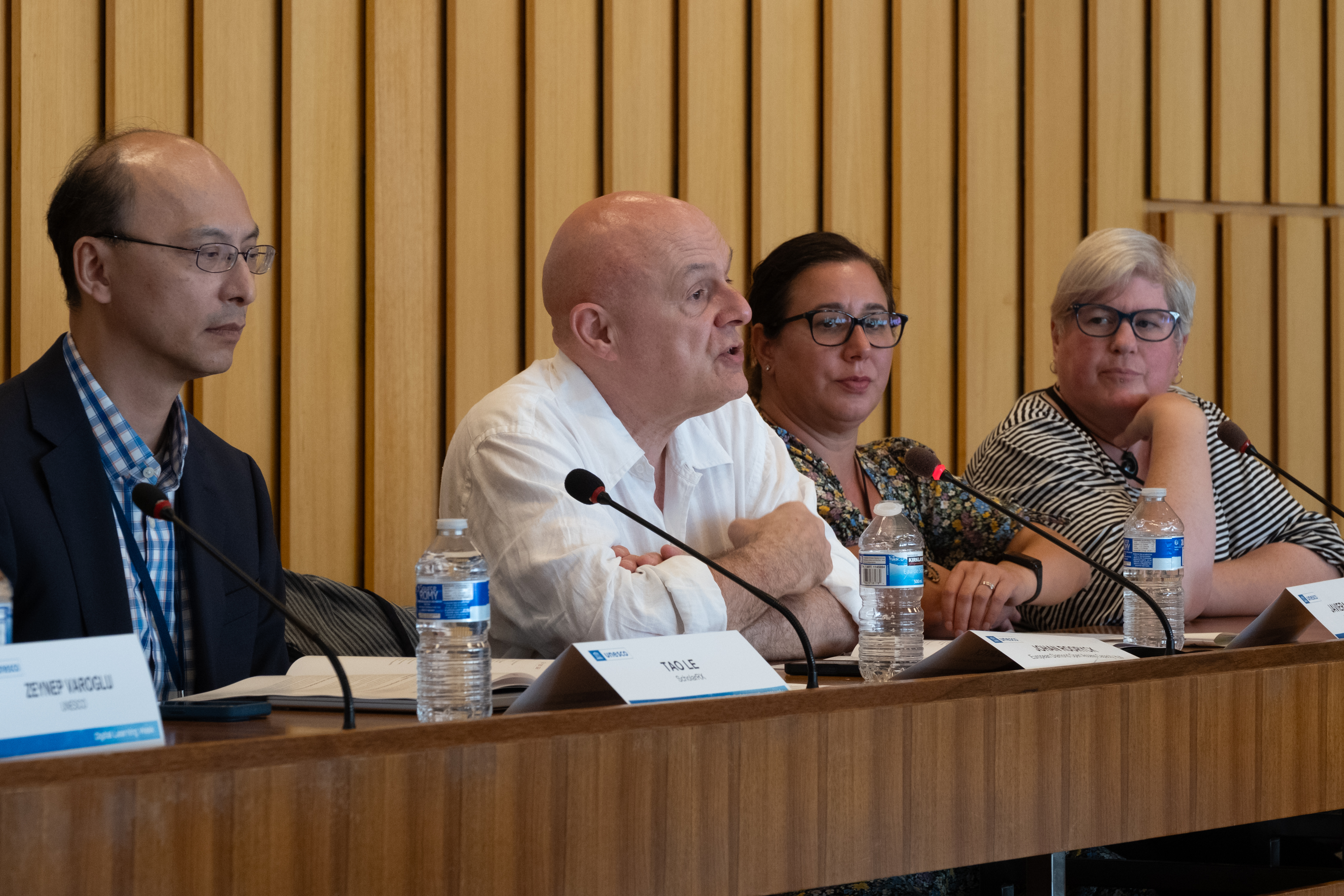
What if Open Educational Resources, Open Access, Open Data and Free and Open-Source Software were not treated as separate approaches, but as connected parts of one open knowledge ecosystem? This would allow knowledge to move more freely across systems, institutions and communities and be accessed, adapted and shared by more people.
As artificial intelligence reshapes how knowledge is created, accessed, shared and reused, this connection is becoming even more important. AI makes it possible to work with knowledge at an unprecedented scale, but it also makes the openness, quality, provenance, accessibility and governance of that knowledge increasingly consequential.
The question, therefore, is how to build an enabling ecosystem in which openness is embedded across the knowledge of lifecycle, from creation and publication to access, adaptation and reuse.
This challenge was at the center of the training session “Policy into Practice: Embedding Openness Across the Knowledge Lifecycle,” organized by UNESCO and the Commonwealth of Learning (COL) on 8 September during Digital Learning Week 2026. Bringing together some 80 participants, the session explored what an Open Solutions approach can mean in practice: connecting policies, infrastructures and communities, and translating openness into coherent governance and concrete institutional action.
Opening the session, Zeynep Varoglu of UNESCO and Anne-Marie Scott of COL framed the discussion around a shared challenge: how can institutions move from individual open initiatives towards a more connected approach to openness and turn that approach into practice?
Participants examined where open policies are already aligned within their institutions, where gaps remain, and how AI is creating both new opportunities and new questions for open knowledge ecosystems.
Dr Javiera Atenas guided participants through this institutional diagnosis, while Johan Rooryck explored Diamond Open Access as a case study in community-governed scholarly communication. The discussion brought questions of governance, funding, standards and multilingualism to the forefront.
The session then moved from policy and governance to practical models. Tao Le and Anne-Marie Scott drew respectively on the ScholarRx OER model and COL’s Frugal AI approach to explore questions of reuse, quality, governance and sustainability in AI-enabled learning.
Across these discussions, a common message emerged: openness becomes more powerful when its different components reinforce one another. Community governance, sustainable funding, interoperability, quality standards, multilingualism and accessibility are part of the infrastructure needed to make an open knowledge ecosystem work.
The session concluded by asking participants to translate these ideas into an institutional commitment. Each participant developed an Open Policy Reflection, identifying one gap, one action, an owner or alliance responsible for taking it forward, and a mechanism for accountability.
This exercise shifted the discussion from what openness should look like to what institutions can concretely do to embed it in their policies and practices.
The questions explored during the session are at the heart of UNESCO’s new Open Solutions series:
Scaling health education through open educational resources
The right to know: open knowledge ecosystems and AI
Unlocking knowledge: diamond open access publishing
Together, they illustrate what Open Solutions can make possible: a more connected approach in which Open Educational Resources, Open Access, Open Data, Free and Open-Source Software and other resources can reinforce one another.
As the international community approaches the 2030 deadline for the Sustainable Development Goals, openness, both as a guiding principle and as enabling infrastructure, remains important to equitable access to knowledge andinnovation.
The Open Solutions approach builds on UNESCO’s normative frameworks, including the 2019 Recommendation on Open Educational Resources, the 2024 Dubai Declaration and on the principle of knowledge as a public good. Connecting policies, infrastructures and communities can help translate these commitments into practice and strengthen inclusive and resilient knowledge societies beyond 2030.